Tuesday, April 16, 2013

4.NF.B.4 Multiplying Fractions with Snap Cubes

Multiply a Fraction times a Whole Number


Mariana uses snap cubes to find 3/7 of 14. To do this, she counts out 14 cubes and makes 7 equal groups. Then she combines 3 of these equal groups to find that 6 is 3/7 of 14.  She can see  
2 + 2 + 2 or 3 groups of 2 to determine this.


Maribel also shows how she constructed the same. This makes it visual and concrete for my bilingual students to see that 3/7 of 14 is 6, and 4/7 of 14 is 8.

The children really enjoy this activity because it made sense to them!


 Rigoberto shows 3 of 4 equal groups of 12. His answer is 3 + 3 + 3 or 3 groups of 3. Therefore, he can see that 3/4 of 12 equals 9.


Mariana records her work on her paper. She proves her answers by drawing pictures of the blocks and circling the number of groups to show her solution.

5/6 of 12 = 10, because she counts out 12 cubes and makes 6 equal groups with them. Then she circles 5 of the 6 equal groups.
Esmeralda also uses the same method to record and show her work. However, she takes another step and shows how she simplified her answers by dividing out common factors. (Careful! The drawing for number 6 doesn't match your answer.)

Esmeralda knows that n/n = 1, so common factors can be factored out in each problem to simplify the answer.


Jessi constructs 2/9 of 18 to prove that his answer is 4.  Again, he counts out 18 cubes, divides them into 9 equal groups, and takes 2 of those groups to find the answer of 4 cubes.


The children made a lot of connections today!  :)


Monday, April 15, 2013

4.OA.C.5 Algebra Growth Patterns


Welcome to Mom and Me Math Friday!

In this lesson, the children started with a basic design unit and then built sequential steps of their pattern, showing how it grew systematically. Here you can see Nathan and his mother working on her "Rose Garden" design.


I asked each child, "What is the rule? How is your pattern growing? Do you need to revise anything so that each step follows your rule?"


"Mom's design is very fancy! Can you help her clarify her thinking and finish building the pattern so it matches her rule?" I asked Nathan.


On Monday morning, Nathan was extremely proud to see Mom's design displayed up on our wall!!  Great job, Mom!!  We are all proud of you.


Diane made "bumblebees." Each bee needed 8 blocks. "My rule is multiply by 8," she smiled. "Because 1 x 8 is 8, and 2 x 8 is 16, and 3 x 8 is 24, so that's how I know."


The children made t-charts to record their growth patterns. On the input side (x), I told them to write the name and number of times they built their design. On the output side (y), I told them to write the "number of blocks" necessary to build that many of their design each time.


 Ana called her design "Fire Turtles."


"I'm counting by nines," she proudly announced. "So my rule is multiply by nine."


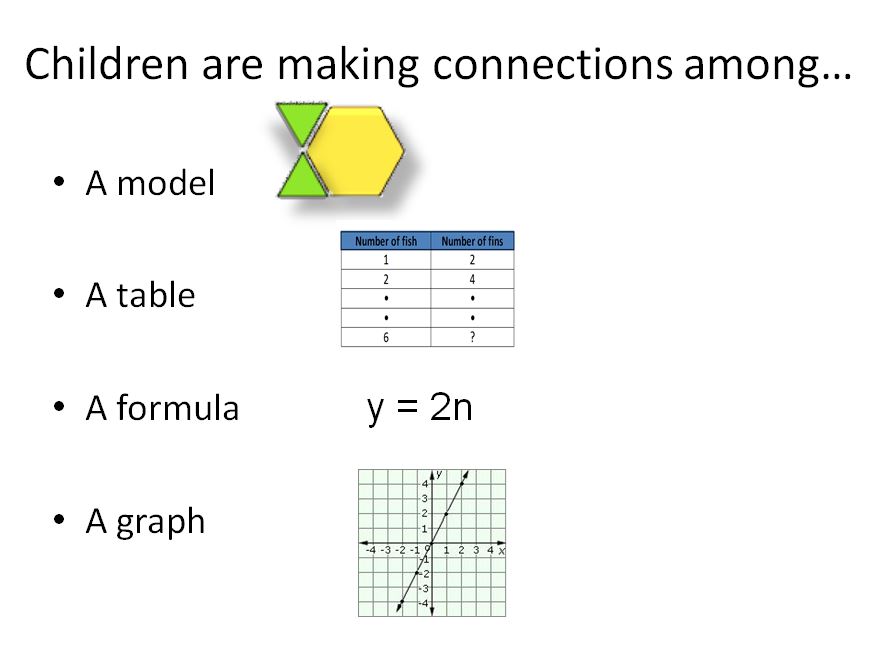
I showed the parents how to help their children make important algebra connections by building a model, creating a table, finding their rule or formula, and graphing it.


How many fins does one fish have?
How many fins do two fish have?
How many fins do 10 fish have?

How can I find out how many fins 100 fish have?

 Kurt made robots.  Each robot needed 9 blocks, so his formula is y = 9n.

 I still need to teach the children the importance of accuracy and being precise, but we are making progress! Kurt made his robots and saw the rule of multiplying by 9, but counted by tens when he wrote this on his t-chart.


Math is fun when it is relevant to the lives of the children. How exciting to make a design that uses the colors of your heritage! Parents and children enjoyed sharing their designs with the class.

I often create PowerPoints for the children. This helps them stay focused on the directions, and allows them to reflect on previous learning. I usually show them photographs of what happened on the previous day, and allow them to build on those ideas--modifying, clarifying, and constructing new knowledge as we go.
   Fatima sparkles as she shares her "Dancing Ducks" and her rule of multiply by 8.


Saul saw that his formula was y = 7n, because each time he needed 7 more blocks to make his rockets.


The following day, we made ordered pairs and graphed our designs.


I gave the students a communication guide and showed them a rubric of how I would grade their work.


Anthony needed 8 blocks to create each of his "Droids." Below is the communication guide he used to write his reflection.


The children had to use pictures, numbers, and words to prove and clearly show their thinking. Everyone felt successful, had a chance to review their time tables, and made important connections with algebra.

Other algebra lessons we did...


This time we did the Marilyn Burn's activity called Banquet Tables.

Anthony knows that the rule is "multiply the table number (n) by 2 and then add 2."


Tommy and Diane said that if you had 1,000 tables, then you would need 2,002 chairs.

After discussing what operations we did each time, the children were able to see that the formula was y = 2n + 2, or multiply two times the table number (n) and add 2 for the two end seats.

Success!!


Here the growth patterns are introducing the concept of multiplying double-digit numbers. In this case, the children are determining...
"What is 4 x 14?


Below are some of our other growth pattern designs:


This is one of my all time favorites showing Crusty the Clown.  :)


Such creativity!!  ....and it makes math fun for these third and fourth graders.


Patricio's "Dogs" 


And of course, Alex's "Football Players."


Here Brandon is helping Alex see that his rule for counting the number of blocks needed to make more football players is to multiply by 6.


Check out our movie:

Alex's Football Players


Saturday, April 13, 2013

4.NF.B.4c Trail Mix Problem

Esmeralda will sell the amount of trail mix made by one recipe for $2.30. She wants to sell packages of different sizes on eBay, so she decides to sell two larger packages that contain 6 cups and 12 cups, and one smaller package that contains 3/4  of a cup.


To represent one recipe portion, we used snap cubes to show 3/4 cup of peanuts (green) plus 1/2 cup of raisins (yellow) plus 1/4 cup of chocolate chips (red). Therefore, one recipe made 1 1/2 cups of Esmeralda's trail mix.

Next, I had table partners push their single recipes together to show how to double the recipe. "How many cups of trail mix do we have now?" I asked. Everyone thought for a moment and then delightedly answered, "Three cups!"

We drew the recipe on graph paper showing one recipe, then doubled it for three cups, and doubled it again to represent six cups.


Leslie and Cristal show 3 cups.


Cesar's paper shows the solution for 6 cups of trail mix, which can also be written as:

4  x  3/4 cup of peanuts
4  x  1/2 cup of raisins
4  x  1/4 cup of chocolate chips


Galilea drew 4 times the recipe correctly, but added 4 cups plus 1/2 + 1/2 + 1/2 + 1/2 = 4  4/8, even though she multiplied 4  x  1/2 correctly.


All of the children struggled with how to fill in the table and ESPECIALLY with how to find the correct ratios for 3/4 cup of the recipe.


Alexis knew that fractions always have equal parts, so "all you have to do is put 1/4  plus  1/4  plus  1/4  and that equals 3/4." He also confused other parts of his table, even though his graph paper illustrations were correct.


Oh dear! I knew I had to think about this one tonight. How will I approach helping the children understand the step of finding 3/4 cup of the recipe?

               Days 2 and 3 of trying to solve the Trail Mix problem


How can we find 3/4 of a cup of the recipe?


Everyone jumped into thinking about how to solved this. I was delighted to watch the culture of the classroom change as they began debating and challenging each other's ideas in trying to make sense of the problem.


Finally, Rigoberto said we could just cut the recipe in half and this would be 3/4 of a cup!

Rigoberto shows the class how 3/4 can also be written as 6/8.


Patricio exclaimed, "I see it! It's 1/8 cup of chocolate chips, 3/8 cup of peanuts, and 2/8 cups of raisins."


Although most of the children are still struggling with fraction concepts, I was so proud of their determination to make sense of the problem and find the correct solution!


               Day 4 of Trail Mix


Collaboration and excitement filled the room all four days of this lesson, which is why I love the Common Core standards. Teaching this way takes much more effort, but is worth it, so take heart!


New friendships were being forged and new levels of trust developed as the children kept sharing their ideas with each other.


Jonathan and Jessi share ideas together.

To close the lesson, each group had a chance to present their ideas to the class. This is another important skill my bilingual students need to develop, and it helps build their confidence.


This time, several showed understanding of how to correctly fill in the table. Jessi saw that he only had to double the numbers again to go from 6 cups to 12 cups of trail mix. Galilea showed her work by multiplying each ingredient by a whole number to show how many times she increased the recipe.

I was also excited about Gabriela's work (shown below).  She told me that you could not simplify 18/4 so I asked, "But how many fourths are in one whole?" Her face brightened. "I get it!" she beamed and circled each of the 4/4 in 18/4. Then she totaled this all up and wrote 4 1/2.


Whew!!  We are starting to make progress!