 5.NF.A.2 Solve word problems involving addition and subtraction of fractions referring to the same whole, including cases of unlike denominators, e.g., by using visual fraction models or equations to represent the problem. Use benchmark fractions and number sense of fractions to estimate mentally and assess the reasonableness of answers.
The more I work with the CORE standards, the more I appreciate the wisdom of slowing down and laying a solid foundation. I have been working all year in my 4th grade class on the concept of fractions, but my students still confuse ideas about "where is the whole"?

We had a lot of fun this week doing The Unusual Baker problem from NCTM.
I asked the class to solve the cake problems individually, before sharing too many ideas with others.

Following this, the children worked in groups, divided the tasks, and heartily discussed the price and fractional size of each cake portion. We worked on this activity for 3 days and still need to review some of the key points.

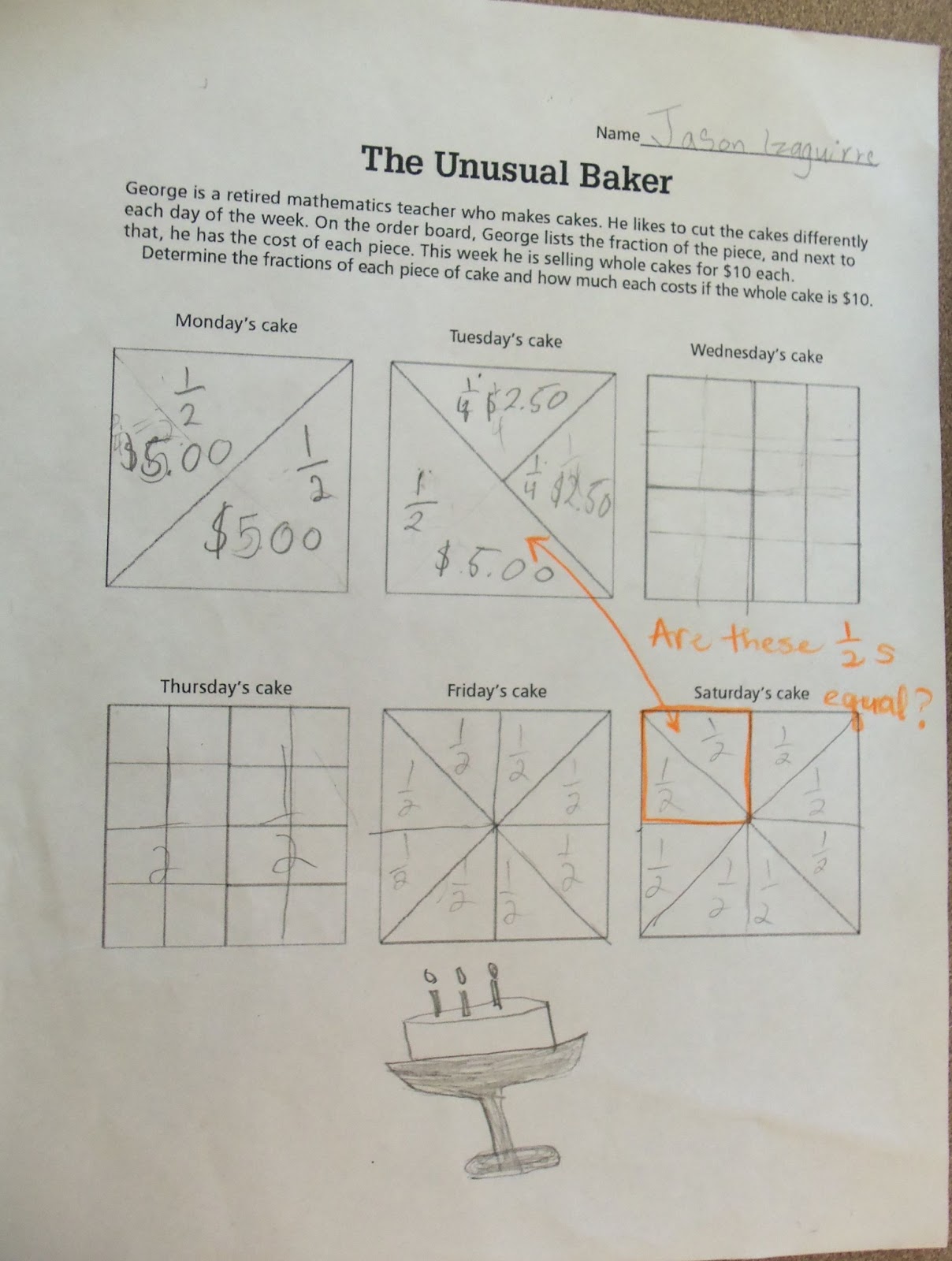
The children could tell me that the cake was cut in half, and that the two equal parts on the right were fourths...but it didn't bother them that $4 did not equal $5!
It took several questions to get them to focus on the numbers as money, and to realize that half of 5 dollars was $2.50.

Another group correctly made the four equal parts and proudly told me that $6 plus $4 was $10--so their answers were correct. (Ugh!) I asked them, "So which fourth would you like to buy, one for $2 or one for $3?" At least they were beginning to realize that their numbers were not reasonable.

A third group showed me 4 equal parts on one side and 2 equal parts on the other. I asked them, "Where is the whole cake? ...Then does it make sense that these long strips are each half of that whole?"

At that point, Cristal's face sparkled as she realized that the smaller portions were eighths. Whew!! We're beginning to make progress.

I showed them how to cut and glue new answers to repair their chart. Next, I will have to have them look again at Thursday's burger in the lower right-hand corner. (Interesting that they wanted to cut and serve portions of burgers instead of cake or pizza.)

Cesar's group understood the problem the best and felt the most confident when they presented their solutions to the class.

Great work, Pizza group!! You rock, Rigoberto!
Great job with the mic, too.

Here is their finished poster. Well done, team.
For most of the class, I still need to reinforce the concept of always finding the whole, and then making sure you are equally dividing the entire area. A fourth of one cake, should match one-fourth of another cake of the same size.

Many of the students still do not have enough confidence to boldly declare that their answers are absolutely correct. So if another group member tells them a different answer, they simply erase without questioning it.
Here Martha knew that half a cake was $5, but she changed it when Angie told her that "It has to be six dollars, because 6 plus 4 is 10. And you can't have 3 plus 3 because that is too big." It never occurred to the group that you could use coins to make the money amounts correctly match the fractional sizes.

Way to go, Cesar!! Good problem solving. Next time don't erase your work; rather, use it to prove your answers.

Even though Esmeralda still needs to finish, she has done an excellent job showing her work and proving her answers. Next, I need to have my students explain their thinking in writing--something they struggle with and need a great deal of practice doing.


Follow-up lesson to clarify fractional parts and cake prices...

Gabriela shows that these "halves" are actually two-fourths of the whole. She is then dividing the whole into eight equal parts to prove that the "fourths" are really eighths.

Angel explains why the two "half" sections on Jason's paper are actually eighths.

Rigoberto shows how he added $1.25 three times to get the value of 3/8 of the cake as being $3.75.

Jorge also explains where the 5/8 are on the circular "cake" and why the price is $6.25.
Stay tuned....we're not done with fractions yet, I'm sure!! Why can't the U.S. just use the metric system like the rest of the world?!!


